
How Much Does That Cake Really Cost? Understanding Recipe Costing

How Much Does That Cake Really Cost? Understanding Recipe Costing
You've spent hours perfecting your recipe. Your cake looks beautiful, tastes amazing, and your customer is delighted.
But here's a question every home baker eventually faces:
Did you actually make any money from it?
It's surprisingly easy to underestimate the cost of homemade cakes, especially when you're turning a hobby into a business.
A little flour here, a few eggs there, some buttercream, a cake board, a box... and suddenly that £35 cake might not be quite as profitable as you thought.
Let's look at how to calculate what your cakes really cost, and how to make sure your hard work is properly rewarded.
Why Recipe Costing Matters
When you're baking for friends and family, you probably don't think too much about the cost of individual ingredients.
But when customers start paying for your creations, those costs become incredibly important.
Knowing the true cost of your recipes helps you:
- Price confidently without constantly wondering whether you're charging enough.
- Protect your profits as ingredient prices change.
- Compare recipes to understand which products are more profitable.
- Avoid undercharging for complicated or ingredient-heavy creations.
- Plan purchases and keep unnecessary spending under control.
Most importantly, it helps you build a baking business that's financially sustainable.
Because as much as we love baking, nobody wants to work for free!
Step 1: Calculate Your Ingredient Costs
Let's start with the obvious: ingredients.
The important thing to remember is that the price of a packet isn't necessarily the cost of the ingredient in your recipe.
For example, imagine you purchase:
- 500g of flour for £1.50
- 250g of butter for £2.50
- 1kg of sugar for £1.60
- 12 eggs for £2.40
Your recipe only uses a portion of those purchases.
To calculate the cost of each ingredient, use this simple formula:
Ingredient cost = (Quantity used ÷ Quantity purchased) × Purchase price
So, if your recipe uses 200g of butter from a 250g block costing £2.50:
(200 ÷ 250) × £2.50 = £2.00
That's the actual cost of the butter in your recipe.
Repeat this for each ingredient, and you'll start building a much more accurate picture of your baking costs.
A Simple Victoria Sponge Example
Let's imagine you're making a basic Victoria sponge cake.
| Ingredient | Quantity Used | Example Cost |
|---|---|---|
| Self-raising flour | 200g | £0.60 |
| Caster sugar | 200g | £0.32 |
| Butter | 200g | £2.00 |
| Eggs | 4 | £0.80 |
| Baking powder | 1 tsp | £0.05 |
| Vanilla extract | 1 tsp | £0.20 |
| Jam | 150g | £0.75 |
| Double cream | 300ml | £1.50 |
| Total | £6.22 |
These are illustrative UK ingredient prices, not current supermarket quotations.
So our Victoria sponge has an estimated ingredient cost of £6.22.
Simple enough, right?
But we're not finished yet.
Step 2: Don't Forget Packaging
A cake doesn't usually leave your kitchen on its own.
Depending on what you're selling, you might need:
- Cake boxes
- Cake boards
- Cupcake inserts
- Labels and stickers
- Ribbons or decorative packaging
- Food-safe wrapping
Individually, these items might seem inexpensive. But over dozens of orders, they add up.
Let's say our Victoria sponge needs a £1.20 cake box and a £0.80 cake board.
That's another £2.00.
Our running total is now:
£6.22 ingredients + £2.00 packaging = £8.22
And we still haven't accounted for the person actually making the cake.
That's you!
Step 3: Your Time Has Value
This is one of the biggest mistakes new home bakers make.
You might think, "Well, I enjoy baking, so I don't really mind spending a couple of hours making the cake."
And that's absolutely fine when you're baking for fun.
But when you're running a business, your time is one of your most valuable resources.
Think about everything involved:
- Preparing and measuring ingredients
- Mixing and baking
- Making fillings and decorations
- Assembling and finishing the cake
- Washing equipment and cleaning up
- Communicating with customers
Even a relatively straightforward cake can take considerably longer than its baking time.
Let's say our Victoria sponge takes 1.5 hours of active work, and you've decided to value your time at £12 per hour.
That's:
1.5 hours × £12 = £18.00
Our running total becomes:
£8.22 + £18.00 = £26.22
That £12 hourly rate is just an example, not a recommended legal wage or universal rate for self-employed bakers. You should choose an appropriate rate and consider your working arrangements and applicable UK requirements.
Step 4: Account for Your Overheads
There's another category of costs that's easy to overlook.
Your oven uses electricity or gas. Your mixer and other equipment experience wear and tear. You use cleaning supplies, water, and perhaps pay for insurance, marketing or business software.
These are your overheads.
Calculating them precisely for every cake isn't always practical, especially when you're just starting out.
One approach is to estimate your monthly business overheads and divide them by the number of orders you expect to complete.
For example:
If your relevant monthly overheads are £100 and you expect to complete 40 orders, you could allocate £2.50 per order.
This is a simplified approach. Different products can consume very different amounts of energy, time and equipment, so you may eventually want a more detailed allocation method.
For our example, let's add £2.50.
That brings the total to:
£28.72
And that's before we've made any profit.
Step 5: Add Your Profit
Here's where things get interesting.
Covering your costs is important, but a business also needs to generate profit.
Profit allows you to replace equipment, invest in better tools, expand your product range and build a financial cushion for quieter periods.
There are two common ways to think about profit when setting prices.
Markup is calculated as a percentage of your costs.
Profit margin is calculated as a percentage of your selling price.
They're not the same thing!
For example, if our cake costs £28.72 to produce and we apply a 30% markup:
£28.72 × 1.30 = £37.34
But if we want a 30% profit margin:
£28.72 ÷ 0.70 = £41.03
That's quite a difference.
Neither percentage is automatically the right one. Your final selling price should also reflect your market, customers, product quality, competition, and the value you provide.
The important thing is to make a deliberate pricing decision rather than picking a number that simply feels reasonable.
Putting It All Together
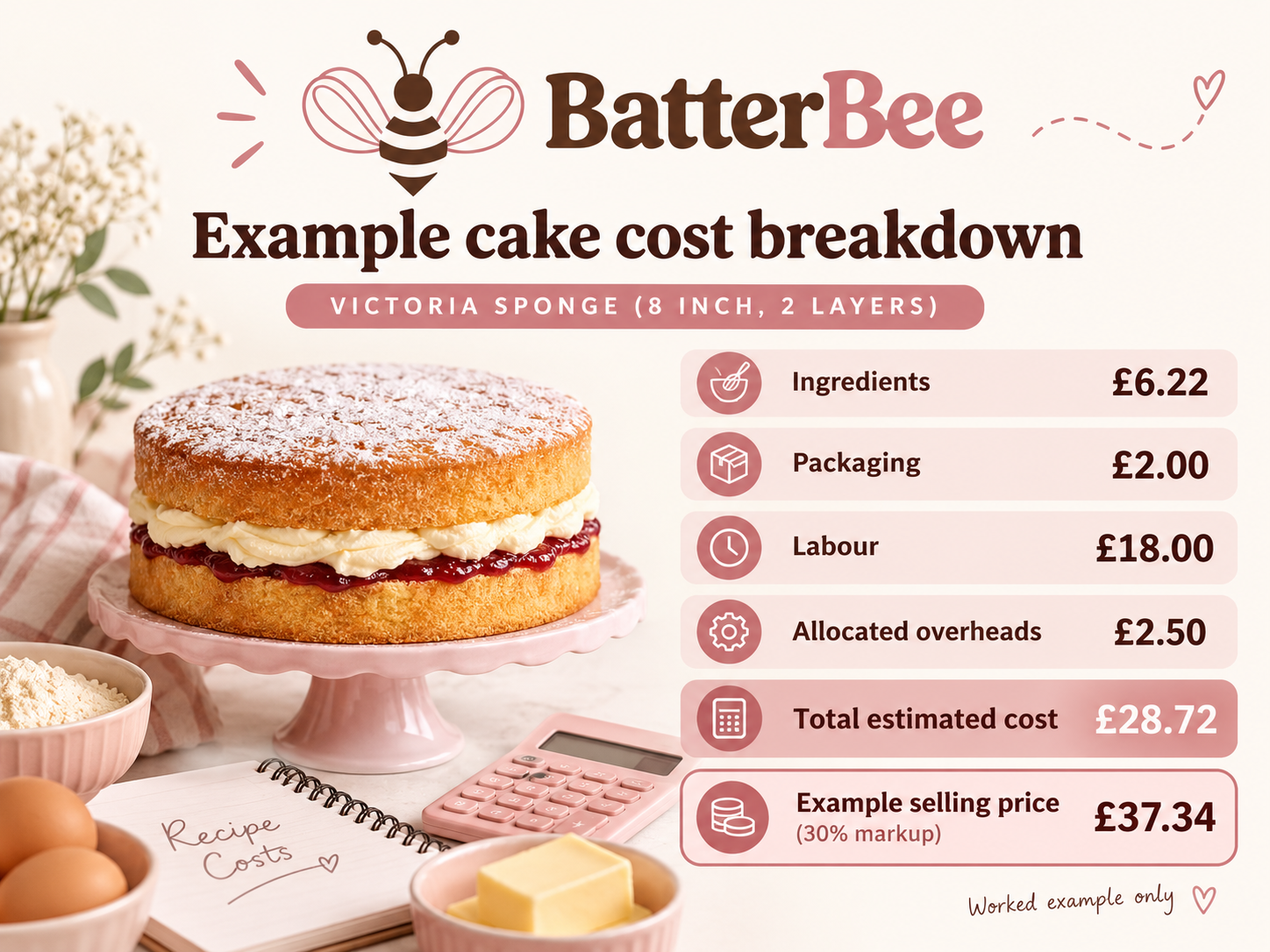
Here's our complete example:
| Cost Category | Amount |
|---|---|
| Ingredients | £6.22 |
| Packaging | £2.00 |
| Labour | £18.00 |
| Allocated overheads | £2.50 |
| Total estimated cost | £28.72 |
| Example selling price (30% markup) | £37.34 |
| Profit above included costs | £8.62 |
That's £8.62 remaining per cake before any additional costs not included in the example, and before applicable taxes.
If you'd originally priced that cake at £25 because it "sounded about right", you'd actually be charging less than your estimated costs.
It's precisely why recipe costing matters.
What Happens When Ingredient Prices Change?
Here's another complication: ingredient prices rarely stay the same.
A block of butter might cost £2.00 one month and £2.50 the next. Eggs, chocolate, flour and cream can all fluctuate.
When you're working with handwritten notes or spreadsheets, keeping everything up to date can become tedious.
And if you're managing multiple recipes, it gets even trickier.
A small increase across several ingredients can quietly eat into your margins without you noticing.
Regularly reviewing your ingredient prices and recipe costs helps you spot those changes before they become a problem.
Making Recipe Costing Easier with BatterBee
If you've made it this far, you're probably thinking:
"That's an awful lot of calculating just to price one cake!"
And you're right.
That's one of the reasons we created BatterBee.
BatterBee is an all-in-one management platform designed for home bakers and small baking businesses.
Its recipe management and costing features help simplify the ingredient-costing side of running your bakery.
Instead of repeatedly calculating quantities and prices yourself, you can:
- Store your recipes with their ingredients and quantities.
- Record ingredient prices and purchase quantities.
- Calculate recipe ingredient costs using the quantities required.
- Manage your pantry, keeping ingredient quantities and costs organised.
- Keep recipes and ingredient information together, making future costing and planning easier.
And because BatterBee also includes order management, shopping lists, a calendar and a public storefront, those recipes can become part of a more connected baking-business workflow.
It's important to remember that ingredient costing is only part of the complete pricing calculation. You'll still need to make appropriate allowances for your labour, packaging, overheads and desired profit.
But removing the repetitive ingredient calculations is a helpful start.
A Few Final Tips for Pricing Your Bakes
Before you go, here are a few habits worth developing.
1. Keep ingredient prices updated. Even small increases can affect your costs over time.
2. Measure accurately. Guessing quantities makes costing less reliable.
3. Track your working time. Include decorating, preparation, cleaning and administration where appropriate.
4. Review your prices regularly. A price that worked six months ago might not work today.
5. Don't apologise for charging fairly. Customers aren't just paying for flour, eggs and sugar. They're paying for your time, experience, creativity and the finished product.
Better Costing, Better Baking
Running a successful home baking business takes more than excellent recipes.
Understanding your costs gives you the confidence to price your work fairly, protect your margins and make informed business decisions.
You don't need complicated accounting software or an elaborate spreadsheet to get started.
Just a clear understanding of what goes into each bake, a little consistency, and the right tools to help you stay organised.
And if you'd like a helping hand with your recipes, ingredient costs and the rest of your baking administration, BatterBee is here to help.
🐝 Explore BatterBee and start your free month
Happy baking!